Enzymes in Baking: How Flour Mills and Industrial Bakeries Specify a Starch-Conversion Grade
For flour mills, premix blenders and industrial bakeries: fungal alpha-amylase dosage, pH, temperature, QC, COA/TDS/SDS, pilot validation and supplier qualification, plus what to send for a quote.
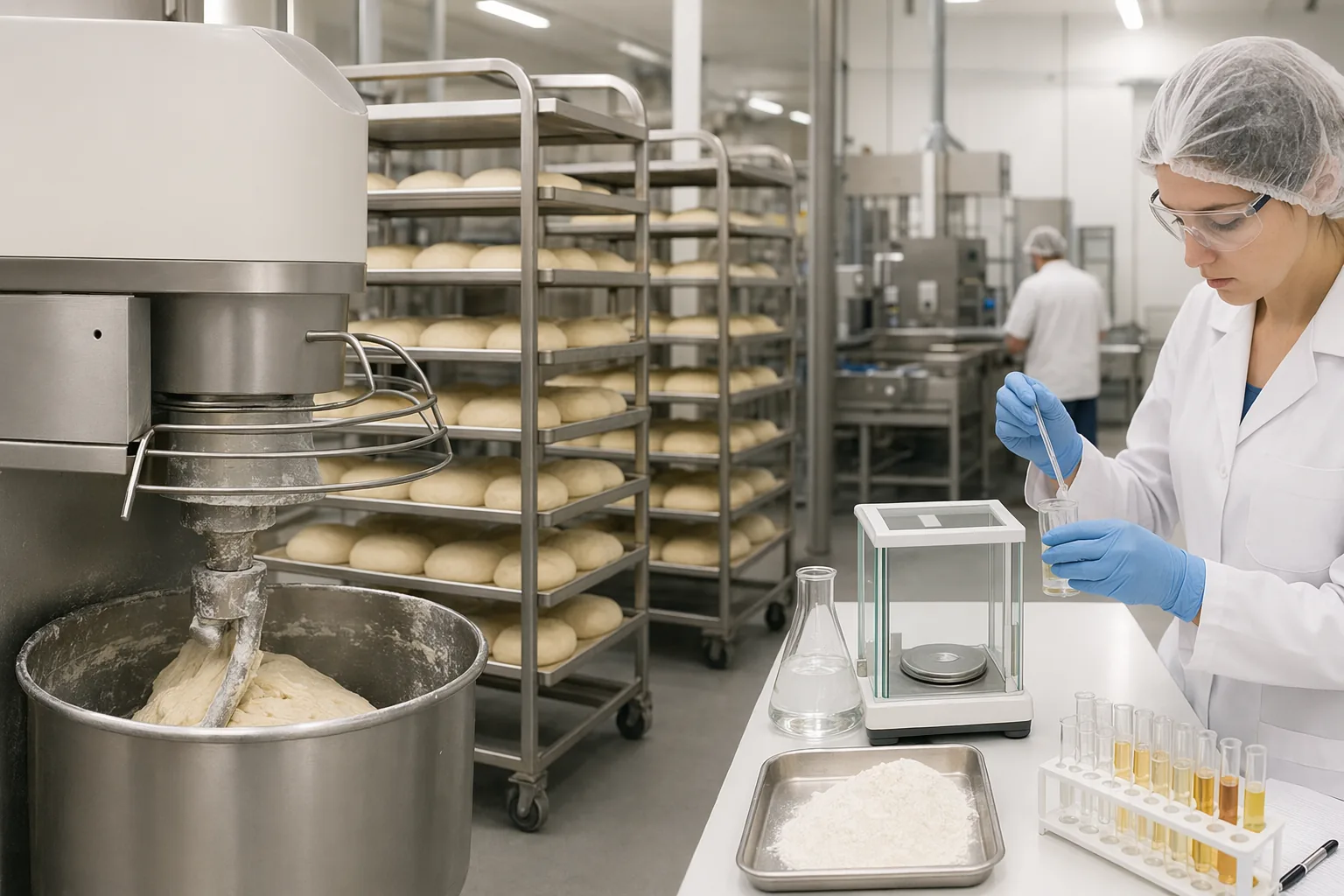
For flour mills, premix producers and industrial bakeries, the reason to add a starch-conversion enzyme is consistency: flour from different harvests and origins behaves differently in the mixer and the oven, and the line still has to run the same way. This page covers where the enzyme fits, how to trial it on your own flour, what to check before approving a grade, and what to send when you ask for a quote: the product, the quantity and the destination.
Why Industrial Buyers Use Enzymes in Baking
Enzymes in baking are processing aids used to improve consistency in dough systems where flour, yeast, water absorption, and process time vary by season and supplier. Fungal alpha-amylase is one of the most common baking enzymes because it hydrolyzes starch into shorter dextrins and fermentable sugars during mixing, fermentation, and early baking. This can support yeast activity, crust browning, loaf volume, crumb structure, and eating quality. For B2B buyers, the goal is not simply higher enzyme activity on paper; it is predictable performance at the lowest cost-in-use without gummy crumb, excessive stickiness, or process instability. A supplier should help align the enzyme grade with bread, cake, or flour treatment applications, then validate it in the buyer’s actual flour and equipment. In the enzymes baking industry, technical support and batch-to-batch consistency are often as important as headline price.
Common applications: pan bread, buns, rolls, cakes, and flour standardization • Primary function: starch conversion for fermentation and color development • Commercial focus: performance consistency, documentation, and cost-in-use
How the Enzyme Works in Dough and Batter
Fungal alpha-amylase acts mainly on gelatinizing or damaged starch, producing dextrins and maltose that can be used during fermentation and contribute to browning reactions. In bread, it is typically selected when the bakery needs better gas production, improved oven spring, more uniform crumb, or support for flour with low natural amylase activity. In cake systems, controlled starch hydrolysis can help texture and eating quality, but dosage must be conservative because high sugar and fat formulas behave differently from lean dough. The enzyme is active during mixing and proofing and is progressively inactivated as internal crumb temperature rises during baking. The grade on this site is specified for pH 4.5–6.5 and 50–60 °C, so it works within normal dough pH and becomes more active as the dough warms. Buyers comparing enzymes for baking should request activity definitions because SKB, FAU, DU, and vendor-specific units are not interchangeable.
Best fit: controlled starch hydrolysis in dough and batter systems • Watch-outs: sticky dough, low sliceability, or gummy crumb if overdosed • Unit conversion: confirm activity assay before comparing quotations
Process Conditions, Dosage, and Trial Design
The starting range for this grade is 5–50 g per tonne of flour; the correct level depends on enzyme activity, carrier dilution, flour damage, recipe, and process time. Some blended baking enzymes are dosed higher because they include carriers or multiple activities. Typical dough pH is compatible with the enzyme, and normal dough temperatures allow gradual action before proofing. During baking, activity declines as crumb temperature rises, commonly becoming largely inactivated above the manufacturer’s specified thermal range. Pilot validation should compare a control against at least two or three dosage levels using the same flour lot, mixing energy, proof time, and bake profile. Record dough handling, proof height, loaf volume, crust color, crumb grain, moisture, firmness over shelf life, and sensory notes before moving to plant scale.
Start with supplier-recommended dosage based on declared activity • Run side-by-side controls using the same flour and process window • Measure both day-one performance and shelf-life texture trends • Confirm that bake conditions deliver adequate enzyme inactivation
QC Checks and Documentation for Supplier Qualification
Industrial baking buyers should qualify fungal alpha-amylase suppliers with both technical and quality documentation. At minimum, request a current Certificate of Analysis, Technical Data Sheet, and Safety Data Sheet for the exact grade quoted. The COA should identify batch number, activity result, method reference, appearance, moisture or loss on drying where applicable, and microbiological limits if relevant for the form supplied. The TDS should state recommended application, dosage guidance, pH and temperature profile, storage conditions, shelf life, carrier composition, and handling precautions. The SDS should address dust control, respiratory sensitization risk, and safe workplace practices for enzyme powders or granules. Supplier qualification should also review traceability, change-control notification, packaging integrity, lead times, and ability to support troubleshooting. A low unit price is less valuable if activity variability forces frequent reformulation or causes scrap in production.
Required documents: COA, TDS, SDS, and batch traceability • Review: activity assay, storage, shelf life, carrier, and packaging • Operational checks: lead time, change control, and technical support
Cost-in-Use and Buying Strategy for Baking Enzymes
The baking enzymes market includes single-activity fungal alpha-amylase, enzyme blends, and customized flour treatment systems. For buyers, the best choice depends on whether the target is fermentation support, volume, crumb softness, anti-staling contribution, or flour correction. Fungal alpha-amylase can contribute to fresher eating quality by optimizing starch breakdown, but dedicated anti-staling enzyme systems often include other amylases, such as maltogenic amylase, depending on the claim and product design. Evaluate cost-in-use by calculating active dosage per metric ton of flour, not just price per kilogram. Include yield impact, scrap reduction, shelf-life extension, and labor savings from fewer process adjustments. Before annual contracting, run pilot and plant trials, approve specifications, confirm documentation, and define acceptance criteria. To compare offers on the same basis, send the product, the quantity and the destination, and ask for the activity unit and dose basis with the quote.
Compare offers by activity-adjusted cost per ton of flour • Separate single-enzyme needs from multi-enzyme blend requirements • Define success criteria before scale-up or contract purchasing
Technical Buying Checklist
Use this list before a flour-treatment grade is approved for a flour mill program or a bakery line.
Flour data first: falling number, damaged starch and protein of the flour lots the grade must cover • Activity unit and assay method on the TDS, so quotes are compared on the same basis • Dose basis (per tonne of flour or per batch) and the starting range: 5–50 g per tonne of flour for this grade • A control plus two or three dose levels on the same flour lot before any plant change • Storage and shelf life: 24 months sealed, cool and dry for this grade • Your quote request: product, quantity and destination
Buyer Questions
Common baking enzymes include alpha-amylase, maltogenic amylase, xylanase, lipase, glucose oxidase, protease, and sometimes cellulase or hemicellulase blends. Each has a different role, such as starch conversion, crumb softness, dough strengthening, dough relaxation, or volume improvement. Fungal alpha-amylase is widely used for starch hydrolysis and fermentation support, but the best system depends on flour quality, formula, process time, and the finished product target.
At plant scale, baking enzymes are usually dosed into flour, improver, premix, or liquid systems according to flour weight and declared activity. The bakery validates dosage through controlled trials, then locks the addition point, mixing time, proofing window, and bake profile. Operators should monitor dough handling, volume, crumb, color, and shelf-life texture. Any flour change may require rechecking the dosage because starch damage and native enzyme activity vary.
Fungal alpha-amylase can support softness and eating quality by modifying starch during processing, but anti-staling performance depends on the product target and formulation. Dedicated anti-staling enzyme systems often include maltogenic amylase or other amylase types designed to slow crumb firming during storage. Buyers should avoid relying on generic claims and instead run shelf-life trials measuring firmness, resilience, sliceability, moisture, and sensory acceptance against an untreated control.
Request a COA, TDS, SDS, activity method, recommended dosage, pH and temperature guidance, storage conditions, shelf life, packaging details, and carrier or allergen information where relevant. Ask for pilot support and define cost-in-use calculations based on activity per ton of flour. Supplier qualification should also cover batch traceability, change notification, lead time, documentation responsiveness, and technical support for troubleshooting during production scale-up.
Fungal Alpha-Amylase (Baking Grade) for Research & Industry
Need Fungal Alpha-Amylase (Baking Grade) for your lab or production process?
ISO 9001 certified · Food-grade & research-grade · Ships to 80+ countries
Frequently Asked Questions
What enzymes are used in baking besides fungal alpha-amylase?
Common baking enzymes include alpha-amylase, maltogenic amylase, xylanase, lipase, glucose oxidase, protease, and sometimes cellulase or hemicellulase blends. Each has a different role, such as starch conversion, crumb softness, dough strengthening, dough relaxation, or volume improvement. Fungal alpha-amylase is widely used for starch hydrolysis and fermentation support, but the best system depends on flour quality, formula, process time, and the finished product target.
How are enzymes used in baking at plant scale?
At plant scale, baking enzymes are usually dosed into flour, improver, premix, or liquid systems according to flour weight and declared activity. The bakery validates dosage through controlled trials, then locks the addition point, mixing time, proofing window, and bake profile. Operators should monitor dough handling, volume, crumb, color, and shelf-life texture. Any flour change may require rechecking the dosage because starch damage and native enzyme activity vary.
What are the signs of overdosing in dough?
Excess amylase activity can cause sticky dough, poor machining, excessive oven color, gummy crumb, weak sidewalls, poor slicing, or a tacky mouthfeel. Problems may be more visible after storage or in high-hydration formulas. If these symptoms appear, reduce dosage, check flour falling number and damaged starch, review proof time, and verify the enzyme lot and weighing procedure.
Can fungal alpha-amylase be used as an anti-staling enzyme?
Fungal alpha-amylase can support softness and eating quality by modifying starch during processing, but anti-staling performance depends on the product target and formulation. Dedicated anti-staling enzyme systems often include maltogenic amylase or other amylase types designed to slow crumb firming during storage. Buyers should avoid relying on generic claims and instead run shelf-life trials measuring firmness, resilience, sliceability, moisture, and sensory acceptance against an untreated control.
What should buyers request before purchasing baking enzymes?
Request a COA, TDS, SDS, activity method, recommended dosage, pH and temperature guidance, storage conditions, shelf life, packaging details, and carrier or allergen information where relevant. Ask for pilot support and define cost-in-use calculations based on activity per ton of flour. Supplier qualification should also cover batch traceability, change notification, lead time, documentation responsiveness, and technical support for troubleshooting during production scale-up.
What should a quote request include?
The product (grade and activity range), the quantity per order or per month, and the destination country. Add the flour type and the application so the grade and the trial plan can be matched.
Request a Quote for Mill or Bakery Supply
Send the product, the quantity and the destination. Request a fungal alpha-amylase baking grade review with COA, TDS, SDS, dosage guidance, and pilot trial support. Our baking enzymes market page lists specs, MOQ, and a free 50 g sample.
Contact Us to Contributehello@mail.enzymepath.com